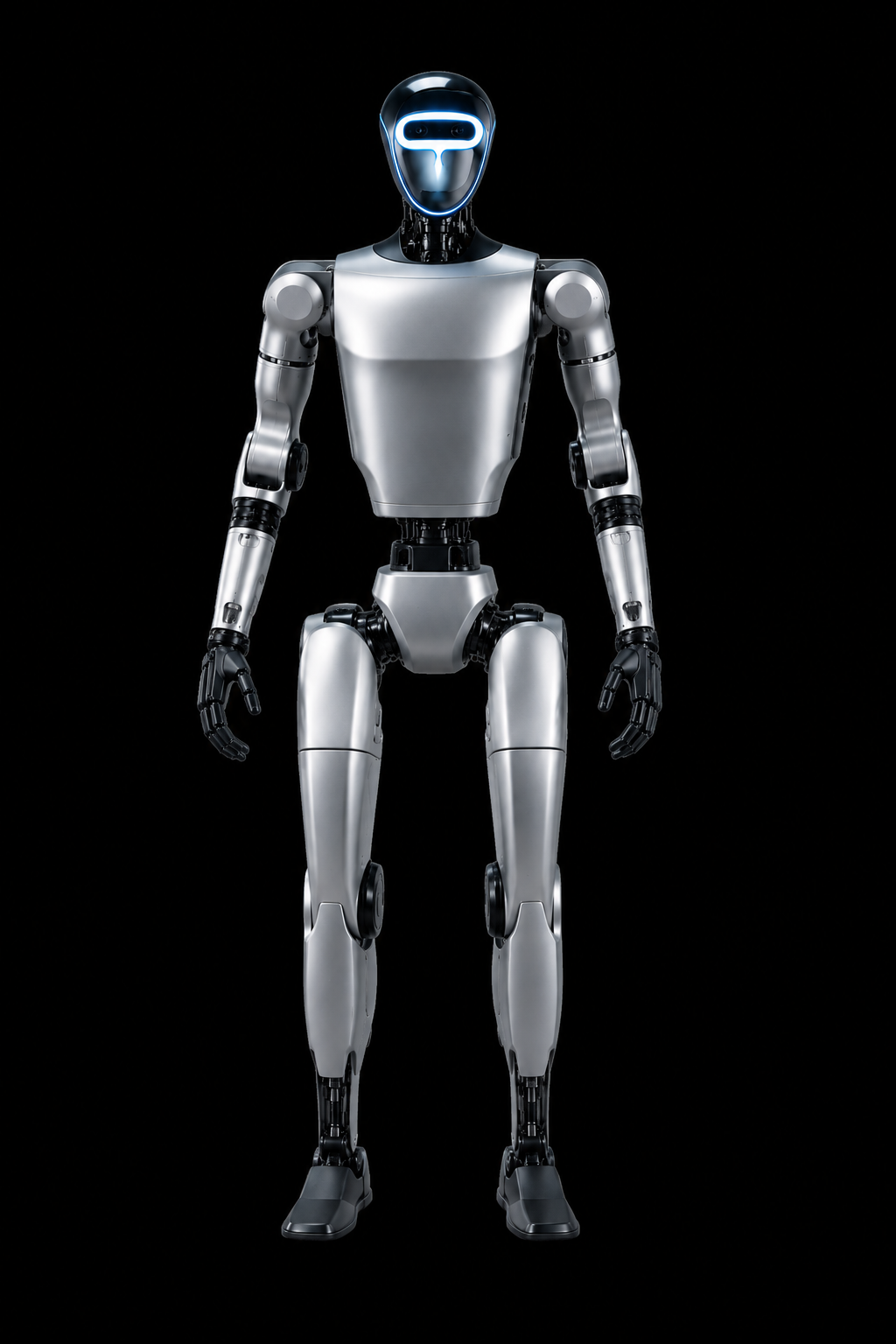
Unitree G1
Unitree G1 is a humanoid robot by Unitree Robotics. This robot profile covers robot specs, history, AI technologies, bipedal locomotion, company background, and real-world use cases.
Description
The Unitree G1 is the world's most affordable humanoid robot, starting at just $16,000. This compact 127 cm robot was designed to democratize embodied AI research by offering an accessible platform. Depending on configuration, it offers 23 to 43 DoF and can be equipped with three-fingered force-control hands and an NVIDIA Jetson Orin. Deployed in 100+ universities across 20 countries. The Unitree G1's $16,000 price point roughly one-tenth the cost of comparable research humanoids democratizes access to full-body bipedal hardware for university labs, independent researchers, and AI companies that previously could not justify the capital expenditure. Its native ROS2 and Python API compatibility ensures algorithms developed in Isaac Sim and MuJoCo can be deployed to hardware with minimal porting effort. Unitree achieved this price point through the same high-volume PMSM motor manufacturing pipeline used in its Go series quadrupeds, applying scale economics from over 50,000 quadruped units shipped to reduce per-actuator cost.
Taken together, Unitree G1 reads as a platform built around height of 127 cm, weight of 35 kg, and dof of 23 to 43, with Onboard NVIDIA Jetson Orin, Three-fingered force-control hands, and Python SDK for rapid development supporting University research in AI and robotics, Embodied AI development platform, and Reinforcement learning experimentation. That makes the profile feel more grounded in how Unitree Robotics Hangzhou, China is positioning the robot for real operating environments rather than as a one-off demo.
Specifications
In practical terms, these figures describe a robot optimized for University research in AI and robotics, Embodied AI development platform, and Reinforcement learning experimentation, while Onboard NVIDIA Jetson Orin, Three-fingered force-control hands, and Python SDK for rapid development define the balance between mobility, perception, and manipulation. The specification set also helps explain the scale of tasks Unitree G1 can realistically handle today.
History
- May 2024: G1 unveiled at ICRA 2024
- June 2024: Pre-orders at $16,000, sold instantly
- August 2024: Mass production in Hangzhou
- Late 2024: G1 deployed in 100+ universities, 20 countries
- 2025: G1 Comp with improved hands and sensors
- 2026: More than 500 units deployed worldwide
Overall, the timeline shows how Unitree G1 moved from research or early unveiling toward clearer operational intent, with each stage tightening the link between height of 127 cm, weight of 35 kg, and dof of 23 to 43 and the jobs it is expected to perform. It also shows how the project matured from concept validation into a more deployment-oriented platform.
Use Cases
- University research in AI and robotics
- Embodied AI development platform
- Reinforcement learning experimentation
- Manipulation and grasping research
- STEM education and demonstrations
- Startup prototyping
Across these roles, Unitree G1 is being framed less as a general-purpose android and more as a system that can repeatedly deliver value in University research in AI and robotics, Embodied AI development platform, and Reinforcement learning experimentation. Onboard NVIDIA Jetson Orin, Three-fingered force-control hands, and Python SDK for rapid development are the pieces that make those scenarios believable, because they connect sensing, planning, and physical execution into one workflow.
Technical Details
The Unitree H1 humanoid robot features high-torque electric actuators like the M107 PMSM motors delivering up to 360 N·m peak torque at the knee, Intel RealSense depth cameras and 3D LiDAR for 360° perception, an AI-powered control system with Intel Core i7 computing for balance and gait, 19 degrees of freedom (5 per leg, 4 per arm, 1 waist), and excels at dynamic locomotion.Unitree,Wikipedia,ROS Components
Taken together, this stack suggests a machine whose real advantage comes from how Onboard NVIDIA Jetson Orin, Three-fingered force-control hands, and Python SDK for rapid development are coordinated around height of 127 cm, weight of 35 kg, and dof of 23 to 43. The result is a platform that can convert perception into stable motion and task execution with less operator intervention than a simpler scripted robot.
Technologies dream
Universal platform at $5,000 accessible to everyone, human-level embodied AI on an embedded processor, self-assembly and self-repair, ability to learn any human trade in one hour, deployment in every household.
Past
Unitree's cost innovation came from vertically integrating motor production for quadrupeds (Go1 at $2,700), then applying the same approach to humanoids.
Present
23-43 DoF configurable, PMSM motors, optional dexterous hands, ROS 2 support, sim-to-real RL locomotion, starting at $16,000.
Future
The Arduino of humanoid robotics a universal research platform enabling thousands of labs to develop embodied AI simultaneously.
Technologies
- Onboard NVIDIA Jetson Orin
- Three-fingered force-control hands
- Python SDK for rapid development
- Isaac Gym / MuJoCo compatible
- Stereo depth camera
- Scalable modular architecture
- USB-C ports for custom sensors
- Real-time VR teleoperation
Together, these technologies show that Unitree G1 depends on a layered architecture rather than one breakthrough component. Onboard NVIDIA Jetson Orin, Three-fingered force-control hands, and Python SDK for rapid development provide the core capabilities, while the surrounding stack determines how well the robot can perceive context, stay stable, and complete tasks without fragile scripting.